
Debut Book · Now Available
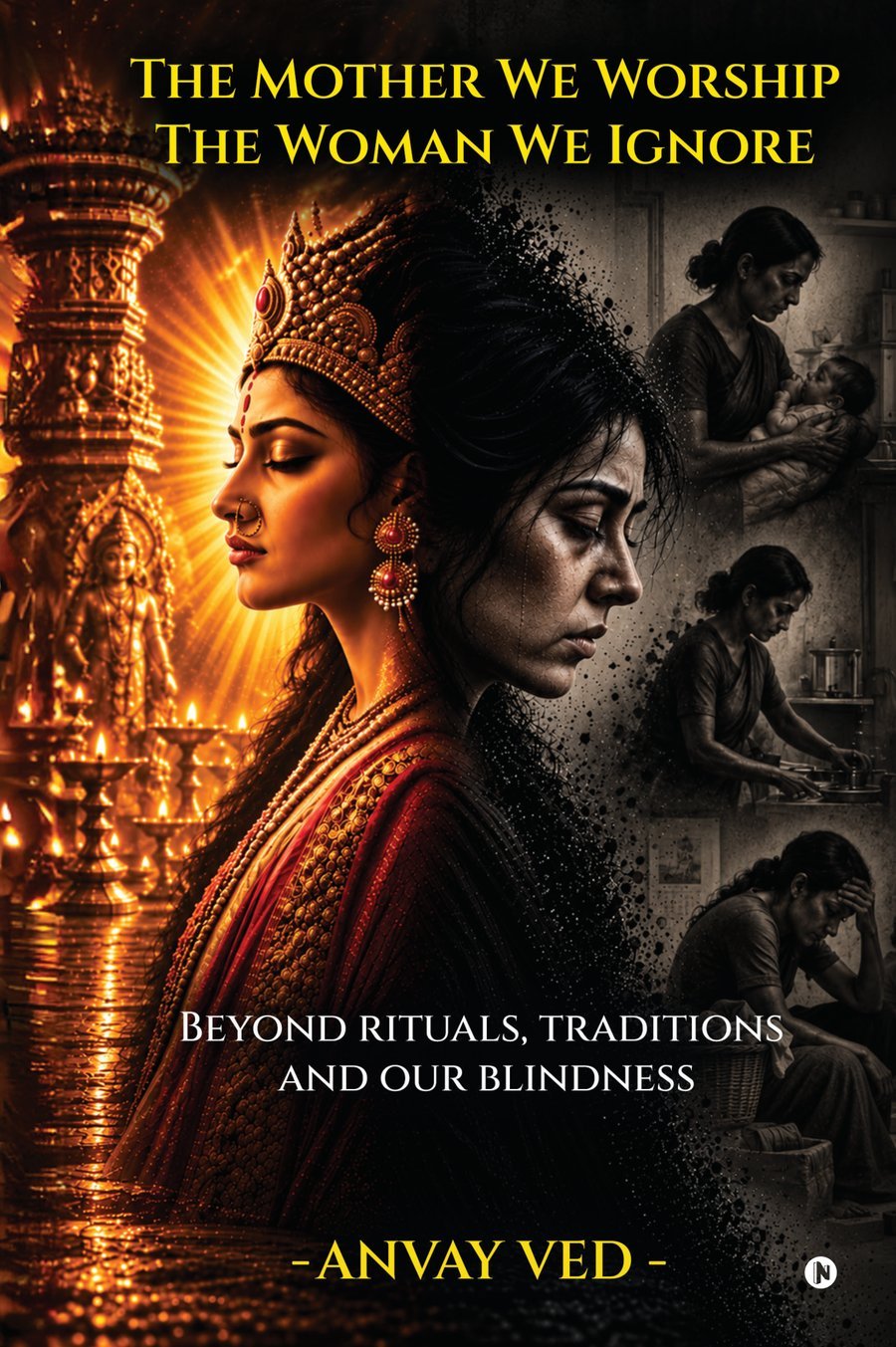
The Mother We Worship. The Woman We Ignore.
Beyond Rituals, Traditions and Our Blindness
Sample Pages
The Mother We Worship
The Woman We Ignore
Beyond Rituals, Traditions and Our Blindness
❀
Anvay Ved
Sample Chapter
❀
The Mother Before the Gods
Why civilizations revered the mother principle before institutions and power.
“She was not rejected outright. She was safely archived — turned from a living awe into a symbol that could be managed.”
— From the Book
Sample Chapter
❀
The Girl Who Learns to Become Small
Never by one command, but by a thousand small corrections.
“No one ever tells a young girl to stop dreaming all at once. Her life is made smaller in tiny drops.”
— From the Book
Sample Chapter
❀
The Wounded Woman Who Guards the Door
When the one who suffered becomes the keeper of the same suffering.
“Not every chain in a woman’s life is held by a man.”
— From the Book
Sample Chapter
❀
The Men Who Were Never Taught to See
A boy is not born ignoring women. The house trains him.
“No baby is born with the capacity to ignore his mother.”
— From the Book
Sample Chapter
❀
The Woman We Ignore
The final mirror.
“The journey does not end with an abstract philosophy, but at the doorstep of your own house.”
— From the Book
The journey begins with the Goddess and ends with one living woman.
❀
Continue reading in the full book
A look inside the book · tap to pause
About the Book
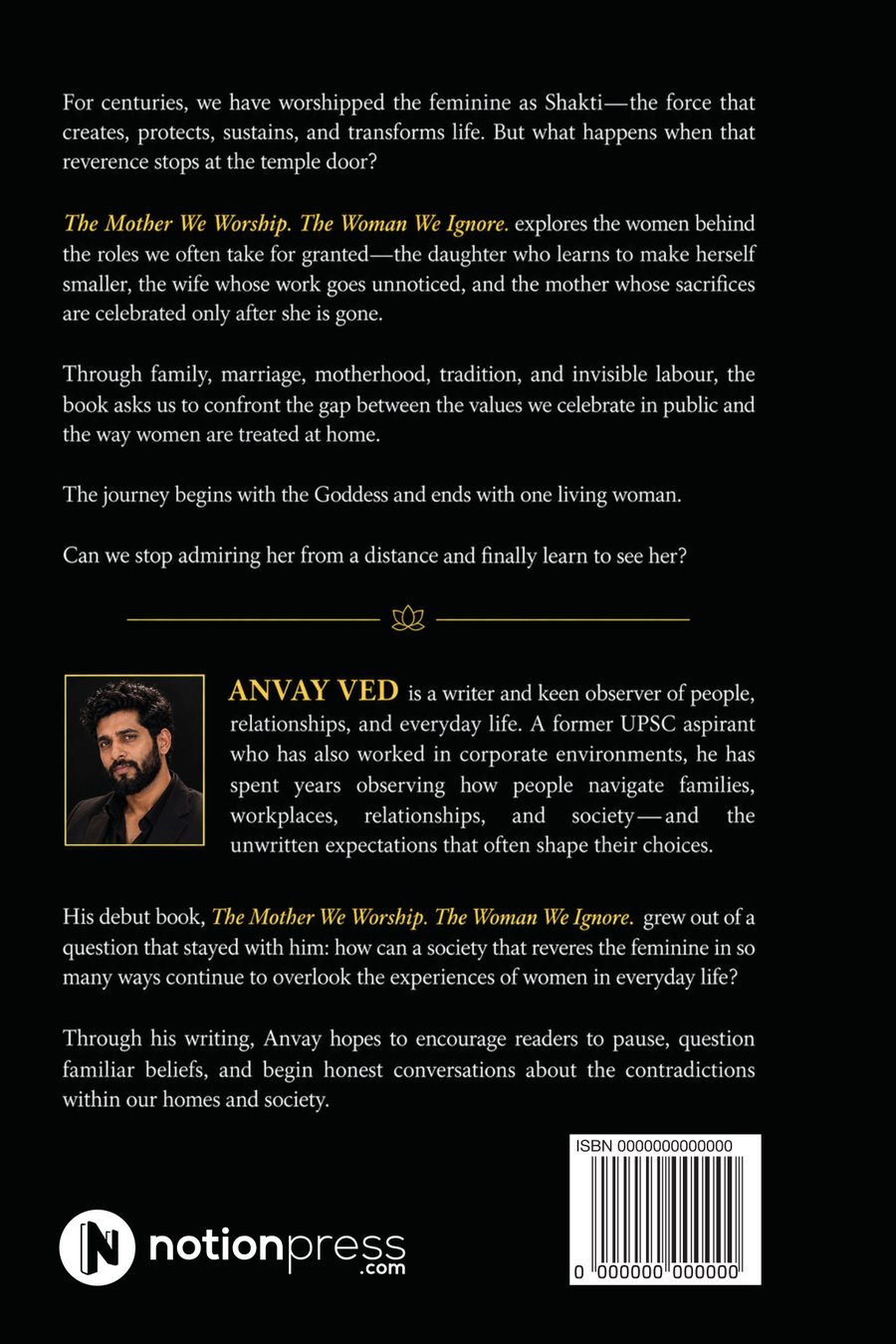
For centuries, we have worshipped the feminine as Shakti — the force that creates, protects, sustains, and transforms life. But what happens when that reverence stops at the temple door?
The Mother We Worship. The Woman We Ignore. explores the women behind the roles we often take for granted — the daughter who learns to make herself smaller, the wife whose work goes unnoticed, and the mother whose sacrifices are celebrated only after she is gone.
Through family, marriage, motherhood, tradition, and invisible labour, the book asks us to confront the gap between the values we celebrate in public and the way women are treated at home.
We light lamps for goddesses and walk past the exhausted woman in the kitchen without a second glance. Drawing on years of quiet observation across Indian homes, workplaces, and family systems, this book asks the question no one wants to answer out loud: why do we worship the symbol and ignore the person it was modeled after? Neither an attack nor a sermon, it is a mirror — for daughters taught to become small, for the men who were never taught to see, and for every home ready to finally look eye to eye.
The journey begins with the Goddess and ends with one living woman.
Can we stop admiring her from a distance and finally learn to see her?
What the Book Explores
Why we worship mothers but ignore women
India imagines the divine as a woman more often than almost anywhere else: Durga, Lakshmi, Saraswati, the earth, the river, the nation itself. Yet the same homes that bow to the Goddess can overlook the woman in the next room. The book looks honestly at this gap between goddess worship and the treatment of women in India, the contradiction many readers describe as Indian society’s hypocrisy towards women, without turning it into an attack on faith.
Navratri, Durga Puja and the women at home
During Navratri and Durga Puja we fast for nine days, honour young girls as the Goddess in Kanya Puja, and celebrate feminine power in every song. Then the woman who cooked the fasting meal eats last, and the daughter we worshipped is taught to sit quietly and become small. The book asks what our festivals would look like if that reverence reached the people inside our own homes.
The invisible labour of Indian mothers and homemakers
Cooking, cleaning, remembering every medicine and birthday, keeping the peace: the invisible labour of Indian mothers keeps families running and is almost never counted. The book looks at the treatment of homemakers in Indian families, at unappreciated housewives who are praised as “the Lakshmi of the house” yet ask permission for every rupee, and at the mothers whose sacrifices are celebrated only after they are gone.
Patriarchy in Indian households
Patriarchy in Indian households is rarely announced. It is taught at the dining table, in who eats first, who decides and who adjusts. The book follows how boys learn not to see, how women who suffered become the guards of the same rules, and how one family at a time can choose differently.
For readers looking for modern books on Indian women’s struggles, The Mother We Worship. The Woman We Ignore. offers something simple and direct: a mirror held up to our own homes.
Inside: Sample Chapters
- The Mother Before the Gods
- The Girl Who Learns to Become Small
- The Wounded Woman Who Guards the Door
- The Men Who Were Never Taught to See
- The Woman We Ignore
Book Details
Price: ₹249
Now Available · Paperback ₹249
Where to Buy
About the Author

Anvay Ved is a writer who pays close attention to people, relationships and everyday life. He prepared for the UPSC Civil Services exam, later worked in corporate jobs, and now writes about the unwritten expectations that shape our choices. More about the author →